A safety switch keeps tripping because it is detecting current leaking out of a circuit, usually through a faulty appliance, damaged wiring or moisture. It cuts the power in milliseconds to stop that leaking current passing through a person. In most cases the switch is working correctly, and the trip is a warning that something on that circuit needs attention.
The most common causes in Brisbane homes are faulty appliances, water getting into outdoor power points or light fittings, damaged wiring, overloaded circuits, storm surges and ageing switchboards. You can safely narrow down a simple appliance fault yourself. If the switch will not reset, trips with everything unplugged, or comes with a burning smell or a tingle from an appliance, it is time for a licensed electrician.
At Solus Spark, we see a steady run of tripping safety switches across Brisbane, and the calls pick up through the summer storm season. Our average response time is under 30 minutes, because a house without power can’t wait long. In our experience, many trips come down to one tired appliance or one wet fitting. The others are wiring or switchboard faults that need a licensed electrician to find and fix. This guide explains how to tell the difference.
What does a safety switch actually do?
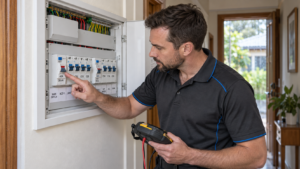
A safety switch, also called a residual current device (RCD), protects people from electric shock. It constantly compares the current flowing out on the active wire with the current returning on the neutral. If the two don’t match, some electricity is escaping to earth, and the switch cuts the power.
Queensland’s Electrical Safety Office puts it simply: safety switches “turn off the electricity within milliseconds when a current leak is detected.” Household RCDs in Australia are typically rated to trip at 30 milliamps. A kettle draws around 10 amps, so the switch reacts to a leak of less than one three-hundredth of that.
That sensitivity is the reason they trip. It is also the reason they save lives.
Is a safety switch the same as a circuit breaker?
No. They sit side by side on most switchboards, but they protect against different things. The Electrical Safety Office notes that “circuit breakers and fuses do not protect people directly, only safety switches save lives.”
| Safety switch (RCD) | Circuit breaker or fuse | |
| What it protects | People, from electric shock | Wiring, from overheating and fire |
| What makes it trip | Small current leaking to earth (around 30 mA) | Too much total current, from an overload or short circuit |
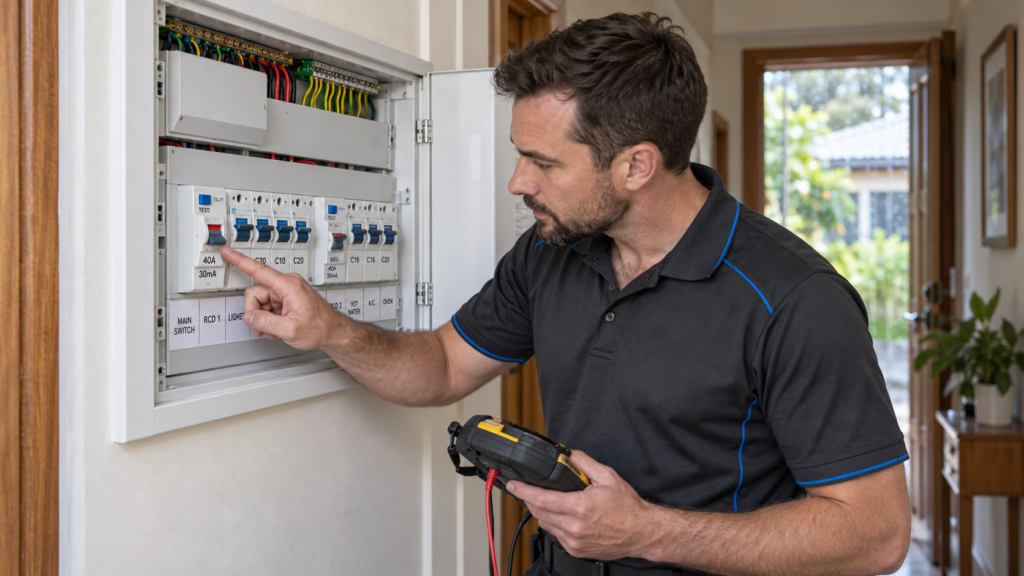
| How to spot it on the board | Has a “Test” or “T” button, usually labelled RCD or safety switch | No test button, labelled with an amp rating such as 16A or 20A |
| What a trip usually means | A fault, moisture or a damaged appliance on that circuit | Too many appliances running, or a short circuit |
Many newer Brisbane switchboards also use RCBOs. These combine a safety switch and a circuit breaker in one device on each circuit, so a trip could be either kind of fault.
Knowing which device tripped is the first clue. If the device that dropped has a test button, current is leaking somewhere on that circuit.
What are the most common causes of a safety switch tripping?
Seven causes account for most of the tripping we see in Brisbane homes. Some are easy to find. Others hide inside walls, ceilings or the switchboard itself.
1. A faulty appliance
A faulty appliance is the most common cause of a safety switch tripping. As appliances age, the insulation inside them breaks down and lets a small amount of current leak to the metal casing or to earth.
Appliances with heating elements are frequent culprits. Kettles, toasters, ovens, cooktops, dishwashers, washing machines, portable heaters and electric hot water systems all fall into this group. Elements can absorb moisture or crack with age, and the RCD trips the moment they switch on.
A classic clue is a switch that trips at the same moment every time, such as when the kettle boils or the dishwasher reaches its heating cycle.
2. Water in power points, lights or outdoor equipment
Water conducts electricity, so even a little moisture in the wrong place creates a leakage path. Outdoor power points, garden lights, pool pumps, air conditioner isolators and exhaust fans are the usual suspects.
Inside, bathrooms and laundries collect steam and condensation. A leaking roof can also drip into a ceiling light or a downlight without you noticing until the switch starts tripping.
3. Damaged or deteriorating wiring
Wiring can be damaged by a nail or screw through a wall, a drill bit, rodents chewing cables in the roof, or plain age. Older insulation becomes brittle and cracks, particularly in roof spaces that bake through a Queensland summer.
A wiring fault is harder to find because you can’t see it. If the switch trips with every appliance unplugged, hidden wiring or a faulty power point is a likely cause.
4. Too many appliances on one safety switch
Every appliance leaks a tiny, normal amount of current to earth. On its own that amount is harmless. When many appliances share one safety switch, those small amounts add up and can push the total close to the trip point.
This is common in older homes where one RCD protects the whole house. Add a computer setup, a fridge, a freezer, a few power boards and an air conditioner, and the switch can start tripping for no obvious reason. Splitting circuits across more safety switches usually fixes it.
A true overload, where the circuit draws more current than it is rated for, normally trips the circuit breaker rather than the RCD. If you have RCBOs, an overload can trip the same device.
5. Storms, lightning and power surges
A lightning strike doesn’t need to hit your house to cause a problem. A surge travelling through the network can briefly upset the balance a safety switch monitors and cause a trip. Storms also drive rain sideways into outdoor fittings and meter boxes.
A trip during a storm is often the switch doing exactly its job. A trip that keeps happening after the storm has passed points to water or surge damage that needs checking.
6. An ageing or faulty switchboard
Switchboards collect dust, insects and corrosion over the years, and all of them can create small leakage paths. Old boards may also have loose or overheating connections.
The safety switch itself can wear out too. This is less common, but an old RCD can become oversensitive and trip at random, or fail to trip at all. Pressing the test button tells you whether it still responds, but only an electrician can properly test its trip time and sensitivity.
7. A new appliance or installation
If the tripping started right after you added something, that new item is the first place to look. A new appliance may be faulty out of the box. A new circuit, such as an EV charger, a spa or a shed supply, may have been wired incorrectly or added to a safety switch that was already near its limit.
Why does a safety switch trip more often in Brisbane?
Brisbane’s humid summers and storm season make moisture-related trips far more common here than in drier cities. Heavy afternoon storms, sideways rain and months of high humidity all give water more chances to reach outdoor power points, garden lighting and roof spaces.
Queensland’s Electrical Safety Office has specific storm safety advice is to “install a safety switch and test it regularly” before storm season, and to “switch off and unplug electrical equipment when a storm approaches.”
A few local patterns are worth knowing:
- Queenslanders and older homes. Raised timber homes often have wiring running through open subfloors and roof spaces exposed to damp air, pests and heat.
- Outdoor living areas. Patios, pool areas and barbecue zones put a lot of power points and lights close to weather and water.
- Overnight hot water. Many South East Queensland homes run their hot water on a controlled load tariff that switches on overnight. If the safety switch keeps tripping in the early hours, a faulty hot water element is a common cause.
- After floods. Any switchboard, power point or hard-wired appliance that has been underwater needs checking before power goes back on.
What should you do when your safety switch trips?
You can safely track down a faulty appliance yourself using the switchboard and your power points. Everything beyond that, including opening the switchboard, removing covers or repairing wiring, is licensed electrical work.
Follow these steps in order:
- Check for danger first. If you smell burning, see smoke or scorch marks, or anything is wet near the switchboard, don’t touch it. Leave the power off and call an electrician.
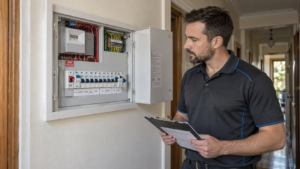
- Find what tripped. Look for the safety switch in the down or off position. Note which circuits it controls, such as power, lights or a specific area.
- Switch off and unplug everything on that circuit. Turn off appliances at the wall and unplug them. For a lighting circuit, switch off all the lights.
- Reset the safety switch. Push it firmly back to the on position.
- Reconnect one item at a time. Plug appliances back in and switch them on one by one. Wait a moment between each. When the switch trips again, the last item you connected is the likely culprit.
- Leave the faulty item unplugged. Get the appliance repaired by a qualified technician or replace it.
- Stop if it won’t stay on. If the safety switch trips straight away with everything unplugged, don’t keep resetting it. The fault is in the fixed wiring, a power point, a light fitting or a hard-wired appliance.
If the trip happened after rain, give outdoor fittings time to dry before resetting. Never force power back into an outlet you know is wet.
How often should you test your safety switch?
The Electrical Safety Office recommends testing your safety switches every three months. A simple reminder is to test them each time your quarterly power bill arrives.
To test, press the “T” or “Test” button on each safety switch. It should click off straight away and cut power to the circuits it protects. Then switch it back on.
If the switch doesn’t click off and the power stays on, it has failed. The Electrical Safety Office’s advice is to contact your electrician to have it checked immediately. A safety switch that doesn’t trip gives you no protection at all.
Remember to reset clocks on ovens and microwaves afterwards, and check the fridge and freezer are running.
When should you call a Brisbane electrician about a tripping safety switch?
Call a licensed electrician if the safety switch won’t stay on, trips with everything unplugged, or comes with any sign of heat, burning or shock. These point to a fault in the fixed wiring or switchboard, which only a licensed electrician can legally repair.
Call straight away if you notice any of these:
- The switch won’t reset, or trips again the moment you switch it on.
- It trips with every appliance unplugged, which rules out a simple appliance fault.
- A burning smell or smoke from a power point, light switch or the switchboard. Turn off power to that circuit if you can do so safely.
- Warm, discoloured or scorched power points, switches or cover plates.
- Crackling, buzzing or popping from outlets or the switchboard, which can mean arcing or loose connections.
- A tingle or mild shock from an appliance, tap or switch. Any shock, even a small one, means current is escaping.
- Water has reached the switchboard or wiring, from a flood, roof leak or storm.
- The tripping keeps coming back on the same circuit, even after you’ve removed a faulty appliance.
Lights that flicker or dim when appliances switch on are less urgent, but they often come before tripping and are worth having checked.
In our experience, the faults that take the longest to find are intermittent ones, such as a switch that trips only during rain or only at 2am. It helps to keep a short record of when it trips, the weather, and what was running at the time. That record often saves an electrician an hour of searching. A licensed electrician can then test each circuit with an insulation resistance tester to pinpoint where the current is leaking. That testing is the core of professional electrical fault finding.
Symptom checklist: what you can check vs when to call
| What you notice | Likely cause | Safe check you can do | Call an electrician if |
| Trips when one appliance turns on | Faulty appliance | Unplug it and reset the switch | It keeps tripping with that appliance removed |
| Trips straight after resetting | Wiring, power point or hard-wired fault | Unplug everything and try once | It still trips with everything unplugged |
| Won’t stay on at all | Wiring or switchboard fault | Don’t force it | Always |
| Trips during or after rain | Water in outdoor fittings or roof | Let the area dry, check outdoor covers | It keeps tripping after things dry out |
| Trips overnight | Hot water element or fridge fault | Note the time it trips | It happens more than once |
| Trips at random, no pattern | Cumulative leakage or ageing RCD | Test the switch with the “T” button | It fails the test or keeps tripping |
| Burning smell, heat or scorch marks | Overheating or arcing | Turn off power to that circuit if safe | Immediately |
| Tingle or shock from an appliance | Earth fault or damaged insulation | Stop using and unplug it | Immediately |
Is it safe to keep resetting a safety switch that keeps tripping?
No. Resetting once to find a faulty appliance is fine. Repeatedly resetting a switch that won’t stay on means repeatedly sending power into a fault, which can cause a shock or a fire.
Never tape a safety switch in the on position, bypass it, or swap it for something less sensitive. In Queensland, only a licensed electrician can install or replace a safety switch, and the Electrical Safety Office states plainly that “DIY electrical work is dangerous and illegal.” The penalties for unlicensed electrical work run up to $40,000 for an individual.
Does your Queensland home have enough safety switches?
Queensland has required safety switches on power point circuits in new homes since 1992, and on both power point and lighting circuits since 2000. Older homes may have only one safety switch covering part of the house, or none at all.
The state’s safety switch rules also apply when a home changes hands or is rented out:
- Buying a home. If the property has no safety switch, one must be installed on the power point circuits within 90 days of transfer.
- Renting out a home. Landlords must have approved safety switches on all power point circuits within 90 days of the tenancy agreement starting.
A home with one old RCD protecting everything is more prone to nuisance tripping, and one fault can black out the whole house. Spreading circuits across several safety switches, or moving to an RCBO on every circuit, limits a trip to the affected area. If your board still uses ceramic fuses, a switchboard upgrade is usually the practical way to get full protection. A periodic electrical safety inspection will confirm whether your safety switches cover every circuit and still work as they should.
Frequently asked questions
Why does my safety switch trip when it rains?
A safety switch that trips when it rains usually has water getting into an outdoor power point, light fitting, exhaust fan or roof space. The moisture creates a leakage path to earth. Check that outdoor outlets have weatherproof covers, and have an electrician find the entry point if it keeps happening.
Why does my safety switch trip at night?
A safety switch that trips overnight often points to an appliance that switches on by itself, such as an off-peak electric hot water system, a fridge compressor or a pool pump on a timer. A failing hot water element is one of the most common causes in South East Queensland homes.
Can a safety switch go faulty and trip on its own?
Yes, although it is less common than an appliance or wiring fault. An ageing safety switch can become oversensitive and trip without a real fault, or fail to trip when it should. An electrician can test its trip current and trip time to confirm.
Why does my safety switch trip with nothing plugged in?
If the safety switch trips with every appliance unplugged, the fault is in the fixed wiring, a power point, a light fitting or a hard-wired appliance such as an oven or hot water system. This needs a licensed electrician to trace.
How much does it cost to fix a tripping safety switch in Brisbane?
Installing a single safety switch in Brisbane typically costs $85 to $200. Tracing a hidden wiring fault usually costs more, because the price depends on how long the fault takes to find. Our guide to Brisbane electrician costs breaks down typical prices for common jobs.
Get your tripping safety switch sorted
A safety switch that keeps tripping is telling you something on that circuit isn’t right. Unplug and reconnect appliances one at a time to rule out a simple fault. Test your switches every three months. Call a licensed electrician if the switch won’t stay on, trips with everything unplugged, or comes with heat, burning or a tingle.
Our team handles fault finding across Brisbane and surrounding suburbs, 7 days a week, including nights, weekends and public holidays. We find the fault, give you one fixed price before any work starts, and back every job with a 12-month workmanship warranty. If you’re comparing options, our guide on choosing a Brisbane electrician covers what to check first. When you’re ready, contact our Brisbane team to book a visit.