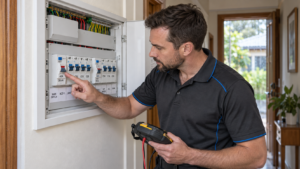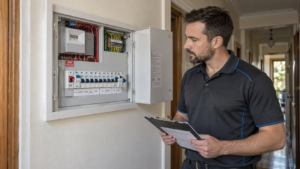
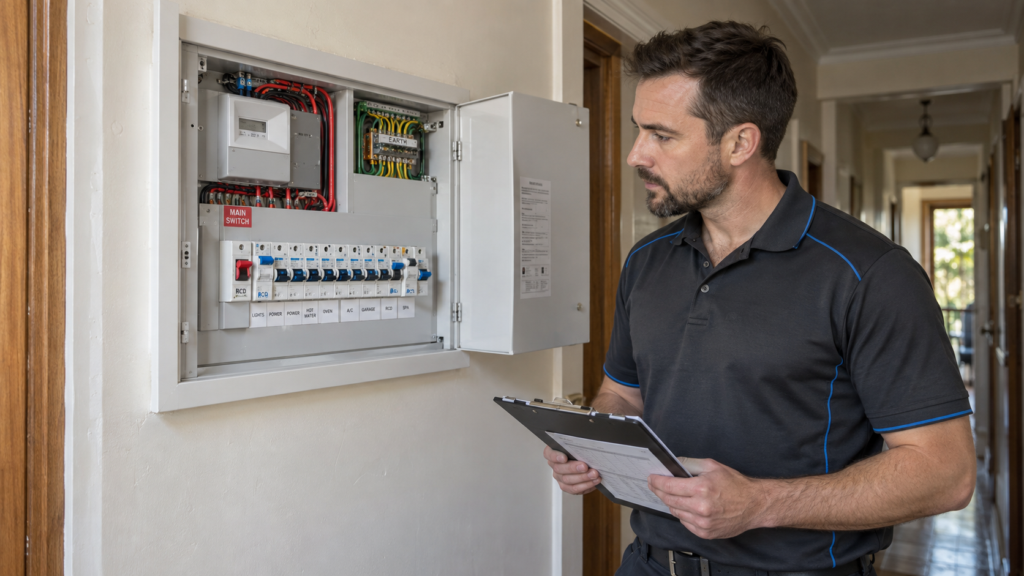
A full switchboard upgrade in Melbourne costs $735 to $2,950 in 2026, and a typical job lands around $1,475. That price usually covers labour, a new enclosure, circuit breakers, safety switches (RCDs), testing and the mandatory Certificate of Electrical Safety. All figures in this guide are in Australian dollars and include GST.
Where your job falls in that range depends almost entirely on the board you have now. At Solus Spark, we upgrade switchboards across Melbourne and regional Victoria. A modern breaker panel swap sits near the bottom of the range. An old ceramic fuse box on asbestos backing sits near the top. We quote one fixed price after we inspect the board, and every job carries a 12-month workmanship warranty.
Below is what a switchboard upgrade costs in Melbourne, what pushes the price up, what the law requires, and how to read a quote before you sign it.
Switchboard upgrade price breakdown for Melbourne homes
Most Melbourne homes pay between $735 and $2,950 for a complete switchboard replacement, according to independent Melbourne cost data. Individual safety switches and labour are priced separately when they are done as standalone jobs.
| Item | Typical Melbourne cost (incl. GST) |
| Full switchboard upgrade | $735 to $2,950 |
| Typical full upgrade | Around $1,475 |
| Individual safety switch (RCD), retrofitted | $160 to $370 each |
| Removing a ceramic fuse board and asbestos panel (example) | Around $420 |
| Electrician labour | $84 to $160 per hour |
The same guide builds up an illustrative price for a pre-1940 Brunswick terrace. It comes to $1,774 in total:
| Line item | Cost |
| Attend, isolate and assess | $94 |
| Remove ceramic fuse board and asbestos panel | $420 |
| New enclosure, main switch, busbar and neutral link | $390 |
| Circuit breakers and RCD protection | $480 |
| Re-terminate and label circuits | $210 |
| Testing, certificate and inspection | $180 |
| Total | $1,774 |
That breakdown is a fair picture of a common inner-north job: an old ceramic board, an asbestos panel, and nothing unusual beyond that. We see plenty of similar boards in Brunswick and the surrounding suburbs.
For a single-phase home without major complications, a budget of $1,000 to $3,000 is realistic. Plan for more if the job involves three-phase power, significant asbestos work or a board that has to be relocated.
What affects the cost of a switchboard upgrade?
Seven factors decide where your quote lands. Some are visible when you open the board, and some only show up once the electrician starts work.
Is it an old fuse box or a modern breaker board?
This is the biggest single factor. Replacing an existing circuit breaker panel is close to a like-for-like job. Converting an old ceramic or rewireable fuse box is a full replacement, because it usually needs a new enclosure, a new main switch and re-terminated supply tails.
| Breaker board replacement | Fuse box conversion | |
| Typical home age | Newer or previously upgraded | Mostly pre-1990 |
| Scope of work | Swap panel and breakers, add RCDs | New enclosure, main switch, breakers, RCDs, new supply tails |
| Likely price position | Lower end of the range | Mid to upper end of the range |
| Surprises to expect | Few | Asbestos, brittle wiring, poor access |
Is there asbestos behind the board?
Many switchboards installed between the 1940s and the mid-1980s were mounted on asbestos-cement sheets. The panel has to be removed under controlled conditions and disposed of properly, which adds time and cost. In the Brunswick example above, removing the fuse board and asbestos panel accounted for $420 of the total. Asbestos backing is the most common reason a Melbourne switchboard quote comes back higher than expected.
Victoria’s asbestos guidance notes that many houses built before 1990 contain asbestos-cement materials. If your home is from that era, assume the backing board needs checking.
Where is the meter and switchboard located?
A board in an external meter box is the easiest to replace. A board tucked into a hallway, a built-in cupboard or another tight spot may need relocating to meet clearance rules. That adds conduit runs, carpentry and labour time.
How many circuits does your home have?
More circuits mean more breakers, more wiring to re-terminate and more testing. A small home with 6 to 8 circuits usually sits at the low end of the range. A large home with 15 to 20 or more circuits can sit near the top.
Do you need single-phase or three-phase power?
Most Melbourne homes run on single-phase 230 V supply, and single-phase jobs make up most switchboard upgrades. Larger homes and workshops sometimes need three-phase power. Three-phase work requires larger switches, extra terminations and often coordination with your distributor. That makes three-phase work one of the more expensive switchboard jobs, so ask for it to be priced as a separate line on the quote.
What condition is the existing wiring in?
Homes with original rubber-insulated or cloth-covered wiring need extra care. Brittle insulation can crack when conductors are moved into a new board. The electrician may need to replace damaged sections or run new conduit, and the quote rises with every circuit that needs fixing.
How many safety switches are being added?
Modern boards include RCD protection on every circuit, and on a full upgrade those RCDs come as standard. Retrofitting them one at a time to an existing board costs $160 to $370 each. On an old fuse board, retrofitting is often impossible, which is why adding safety switches so often turns into a full upgrade.
What are the signs your switchboard needs upgrading?
An old switchboard gives plenty of warning before it fails. These are the signs we see most often in Melbourne homes:
- Ceramic or Bakelite fuse holders. Round porcelain fuses with fuse wire inside are pre-1990 technology. They can overheat or corrode and offer no earth-leakage protection.
- Frequent tripping or blown fuses. Nuisance tripping when you run modern appliances points to an overloaded board.
- Flickering lights. Lights that dim when the air conditioner, oven or heater starts suggest the board is struggling with the load.
- No safety switches. A board without RCDs leaves your household exposed to electric shock and does not meet Victorian rental standards.
- Burn marks, discolouration or rust. These point to overheating or moisture damage inside the board.
- No spare space. If several outlets share one fuse, or there is no room for new breakers, you cannot add dedicated circuits for an EV charger, air conditioner or solar inverter.
Tripping and flickering can also come from a single faulty appliance or circuit, so it is worth confirming the cause first. Proper fault finding and repair tells you whether the board is the problem or just one circuit is.
Do Melbourne rental properties need a switchboard upgrade?
Yes, if the property still has an old fuse board without safety switches. Victoria’s rental minimum standards state that “rental properties must have modern switchboards, with circuit breakers and electrical safety switches installed.”
Consumer Affairs Victoria also notes that on older fuse boards, an electrician “may not have the option of adding circuit breaker components” and “may have to replace the entire switchboard.” For landlords, that makes the switchboard the item most likely to need attention before a new lease. A pre-lease electrical safety inspection confirms whether the board meets the standard before a renter moves in.
What certificate do you need for a switchboard upgrade in Victoria?
Every switchboard upgrade in Victoria needs a Certificate of Electrical Safety (COES) from a licensed electrician. Work on main switchboards is classed as prescribed electrical work by Energy Safe Victoria, alongside consumer mains and main earthing systems.
Prescribed work carries two extra requirements:
- Independent inspection. A licensed electrical inspector must check the work before it is connected to supply.
- Certificate timing. Energy Safe Victoria says the electrician will give you a copy of your COES within 4 days of completion once the inspection is done.
An electrician cannot refuse to issue a COES, even over a payment dispute. If you never receive one for work done in the last three years, you can lodge a complaint with Energy Safe Victoria.
Any quote should include the COES and the inspection fee. If a price sits well below the typical range, ask whether the certificate is included. You can also confirm the electrician’s licence on the Energy Safe Victoria register. Only a Registered Electrical Contractor or Licensed Electrical Worker can issue a COES, so a quote from anyone else is a red flag.
How long does a switchboard upgrade take?
A standard switchboard replacement takes 3 to 5 hours, and the power is off for most of that time. Most jobs finish the same day. A large board or unexpected wiring problems can stretch the job into a full day, but electricians plan to have your power back on by evening.
Here is what the process usually looks like:
- Inspection and quote. The electrician assesses the existing board. Sending photos of the open board beforehand helps spot asbestos or access problems early.
- Power shutdown. On the day, the supply is isolated and switched off.
- Old board removal. The fuse box or breaker panel comes out. Any asbestos backing is removed and disposed of safely.
- New board installation. A new enclosure goes in with a main switch, neutral bar, circuit breakers and RCDs. Existing circuits are re-terminated and labelled, with spare space left for future circuits.
- Testing. Every circuit is tested for correct connection and RCD operation, and the results are recorded on the COES.
- Inspection and reconnection. The independent inspector checks the work, and the power is restored.
Keep the COES with your home records once you receive it. You will need it if you sell the property or make an insurance claim.
Do you need a switchboard upgrade for solar, a battery or an EV charger?
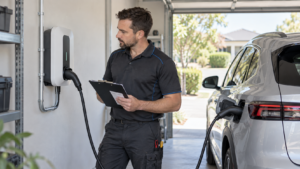
Often, yes. Solar inverters, home batteries and EV chargers all need dedicated circuits and RCD protection. An old fuse board rarely has the capacity or the spare space to take them safely.
In our experience, the cheapest time to upgrade the switchboard is before or alongside the new equipment. Doing it in one visit shares the shutdown, labour and certification across both jobs. If you are planning an EV charger installation or solar and battery connections, ask for the switchboard to be assessed in the same quote.
Why do older Melbourne homes cost more to upgrade?
Old fuse boards were built for a house with a fridge, a kettle and one telly. Melbourne’s housing stock is older than many Australian cities, so a lot of those boards are still in service. Inner-city terraces and mid-century suburbs still have plenty of fuse boxes and early breaker panels. Those homes are also the ones most likely to have asbestos backing boards and meters tucked inside internal cupboards.
That combination explains why the upper end of the range is so common here. For example, a 1960s home with a fuse box in a hallway cupboard might need a full conversion, asbestos removal and a relocated board in one job. A home that already has a breaker panel usually needs a simpler swap. Across our Melbourne electrical services, the age of the home is the best early predictor of the final price.
Do you need a full switchboard upgrade or just a repair?
Replacing one faulty breaker, or a main switch with another of the same rating, is a minor repair. Converting fuses to breakers, adding RCDs, increasing capacity or relocating the board all count as upgrades. Those require the full scope: new panel, testing, inspection and certification.
Adding a single RCD to an otherwise modern board can be done on its own. But if you need several new circuits and modern safety switches, upgrading the whole board at once is usually better value than paying for piecemeal visits.
How can you avoid surprise costs on a switchboard upgrade?
Most bill shock on switchboard work comes from asbestos, access problems and missing certificates. A few checks keep the quote predictable:
- Send photos of the open board before the quote, so asbestos and access issues are priced upfront.
- Get a fixed price in writing rather than an hourly estimate.
- Confirm the COES and inspection fee are included.
- Ask how many RCDs are included and whether every circuit is protected.
- Ask about spare capacity if you plan to add solar, a battery or an EV charger later.
- Check the electrician’s licence before any work starts.
For a broader look at labour rates and call-out fees, our guide to what Melbourne electricians charge covers general pricing. For help comparing contractors, see our guide on choosing an electrician in Melbourne.
Frequently asked questions
How much does it cost to convert a ceramic fuse box to circuit breakers?
Converting a ceramic fuse box to a modern circuit breaker board usually sits in the mid to upper part of the $735 to $2,950 range. The job needs a new enclosure, main switch, circuit breakers, RCDs and re-terminated supply tails. An asbestos backing panel adds to the price.
How much does it cost to add one safety switch to an existing board?
Adding a single safety switch (RCD) to an existing breaker board costs $160 to $370. On a full switchboard upgrade, RCDs are included as standard.
How much does asbestos removal add to a switchboard upgrade?
In one illustrative Melbourne example, removing a ceramic fuse board and its asbestos panel cost $420. Asbestos backing is the most common reason Melbourne switchboard quotes come in higher than expected.
Can I stay home during a switchboard upgrade?
Yes, but the power will be off for 3 to 5 hours on a standard job. Keep your phone charged, and empty or avoid opening the fridge and freezer while the supply is off.
Get a fixed price for your switchboard upgrade
Most Melbourne switchboard upgrades cost $735 to $2,950, and the board you have now decides where you land. Know your range, ask about asbestos and three-phase work upfront, and make sure the Certificate of Electrical Safety is in the price.
If you want a fixed price before any work starts, contact our Melbourne team. We inspect the board, quote one total price for our switchboard upgrade service, and back every job with a 12-month workmanship warranty.