
A licensed electrician in New South Wales charges $85 to $130 per hour for standard residential work during business hours in 2026, plus a call-out fee of $80 to $150 in metro areas. After-hours and emergency work costs far more: expect a call-out fee of $180 to $350 and an hourly rate of $150 to $250. All figures here are in Australian dollars and include GST.
Those ranges are why two quotes for the same job can differ by hundreds of dollars. At Solus Spark we work across Greater Sydney and regional NSW, and we quote one fixed price after we diagnose the work, so the quote you receive is the invoice you pay. Every job carries a 12-month workmanship warranty, and the most common question we get on the phone is what a job will cost before anyone books it in.
Here is what electricians actually charge in NSW in 2026, job by job, along with what moves the number up or down and how to read a quote before you accept it.
What is the average hourly rate for an electrician in NSW?
Licensed electricians in NSW typically charge $85 to $130 per hour for daytime residential work, with most standard jobs landing near the middle of that range. The rate depends on the time of day, the complexity of the work, and where you are in the state.
- Standard hours (Monday to Friday, business hours): $85 to $130 per hour, plus a call-out fee.
- Evenings, weekends and public holidays: roughly 1.5 to 2.5 times standard rates.
- Emergency and after-hours: $150 to $250 per hour once the initial call-out fee is paid.
Hourly pricing suits small, obvious jobs. The drawback is that you do not know the final cost until the work is finished, so a job that runs long costs you more. For anything with an unknown scope, a fixed quote is the safer arrangement.
How much is an electrician’s call-out fee in NSW?
A call-out fee covers travel and the first stretch of time on site. In NSW metro areas it usually runs $80 to $150 for a standard weekday visit, and many electricians include the first 15 to 30 minutes of labour in that fee.
Call-out fees are where surprise costs creep in. A 20-minute repair turns into a three-figure invoice when a separate call-out charge, an hourly rate and an after-hours loading are stacked on top of each other. Some contractors also add a fixed travel charge of $50 to $200 for work outside their normal service area, which matters in regional and rural NSW.
Two questions settle this before anyone gets in the van:
- Is there a call-out fee, and how much is it?
- Is it included in the quoted price, or added to it?
How much do common electrical jobs cost in NSW?
Most small residential jobs in NSW land between $150 and $650, while switchboard, rewiring and solar work runs into the thousands. The table below covers typical NSW ranges for common residential work in 2026, including labour, materials and GST. Treat these as benchmarks rather than quotes.
| Job | Typical NSW cost (2026) | What drives the range |
| Daytime labour | $85 to $130 per hour | Job complexity, contractor overheads |
| Standard call-out fee | $80 to $150 | Distance, time of day |
| Single power point (indoor) | $150 to $280 | Wiring access, new circuit or existing |
| Double power point | $170 to $300 | Roughly $20 to $40 more than a single |
| Outdoor weatherproof power point | $250 to $450 | Weatherproof enclosure, cable run |
| LED downlight (replacement) | $60 to $100 per fitting | Drops per light when several are done at once |
| New light point (ceiling box and wiring) | $250 to $450 | Ceiling access, distance from switchboard |
| Ceiling fan supply and install | $350 to $650 | Fan quality, existing wiring |
| Safety switch (RCD) per device | $180 to $350 | Board type, spare capacity |
| Switchboard upgrade, 3-bedroom home | $1,200 to $2,500 | Number of circuits, condition of board |
| Switchboard upgrade, 4+ bedrooms | $3,000 to $4,000 | Extra circuits, high-demand loads |
| Fault finding and diagnosis | $150 to $350 (up to $800+) | How hidden the fault is |
| EV charger install (7 kW) | $1,200 to $2,200 | Cable run, switchboard capacity |
| Full rewire, 3-bedroom home | $8,000 to $15,000 | Home size, access, wall type |
| 6.6 kW solar system, installed | $4,000 to $8,000 | Panel and inverter quality, roof access |
| Emergency after-hours call-out | $180 to $350 | Plus $150 to $250 per hour after that |
Three patterns run through that list.
Small jobs have a floor. Adding a power point takes minutes of actual work, but it still involves a licensed trade, testing and compliance paperwork. That floor sits in the low hundreds and it does not move.
Large jobs have enormous internal range. The gap between $1,200 and $4,000 on a switchboard is the difference between a straightforward panel swap and a board with more circuits, high-demand loads and a safety switch on every circuit.
Newer work is priced by the cable run. On EV chargers and solar, the distance between your switchboard and the equipment usually drives more of the cost than the hardware does.
How much does electrical fault finding cost in NSW?
A straightforward fault diagnosis takes one to two hours and costs roughly $150 to $350. Complicated faults, such as hidden wiring damage or a problem spanning several circuits, push into the $350 to $800 or more range.
Fault finding is diagnostic work, which is why it is priced differently to installation. The electrician is isolating circuits, testing under load and eliminating causes, and a fault that only appears when the dryer runs on a wet day takes longer to catch than one that trips instantly.
Two things reduce the bill. Note exactly when the fault appears, since a pattern you have already spotted saves the electrician a testing cycle. And book it in normal hours if the power is still on, because a single dead circuit rarely justifies emergency rates. Our own fault finding and repair callouts follow that order: diagnose first, then quote the repair as a fixed price before anyone starts work.
How much does a switchboard upgrade cost in NSW?
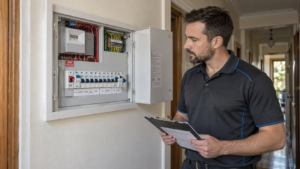
A complete switchboard replacement in a typical three-bedroom NSW home costs $1,200 to $2,500. Larger homes with four or more bedrooms, or homes adding high-demand loads such as air conditioning or an EV charger, generally run $3,000 to $4,000.
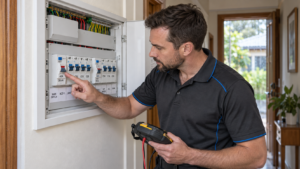
Those prices assume the old ceramic fuses come out and modern circuit breakers plus full RCD protection go in. Two related costs are worth knowing:
- Safety switches (RCDs) fitted individually: $180 to $350 per device. Adding two RCDs to a board that has none typically costs $350 to $600 in total.
- Three-phase service upgrade: $3,500 to $7,000, plus any distributor fees. This is uncommon in homes but shows up on properties adding large loads.
Older NSW housing stock is the reason switchboard upgrades come up so often. NSW Government guidance recommends having your wiring inspected if the home was built before the 1980s, and notes that homes built from 2000 onwards will already have safety switches fitted.
How much does it cost to install power points and lighting?
A single indoor power point costs $150 to $280 installed, including the outlet and labour. A double outlet is only marginally more, usually $20 to $40 on top, because the labour is nearly identical.
- USB power point: $180 to $300 each
- Outdoor weatherproof outlet: $250 to $450
- 15 amp outlet (caravan or EV slow-charge): $300 to $500
- Moving or replacing an existing outlet: $100 to $150
Lighting is priced per fitting. Replacing an existing downlight with an LED runs $60 to $100 per light, while a simple ceiling light or panel is $80 to $150. Pendants cost $120 to $220, and chandeliers range from $200 to $600 depending on size and weight. Outdoor and security lights are typically $150 to $300 per fitting.
The number that surprises people is the new light point. If there is no existing wiring at that spot, adding a ceiling box and cabling costs $250 to $450 before the fitting itself. Cost falls sharply per item when several outlets or lights are done in a single visit, because the call-out, setup and access time are shared across the job. Bundling is the easiest saving available on small work.
How much does it cost to rewire a house in NSW?
A full rewire of a three-bedroom house in NSW typically costs $8,000 to $15,000. Larger or more complex homes run $15,000 to $25,000. Partial rewiring, such as kitchen and bathroom circuits only, is far less at $2,000 to $6,000.
A full rewire covers removal of the old wiring, new cabling throughout, a new switchboard, new outlets and light points, and testing and certification at the end. It is usually triggered by one of three things: rubber-insulated wiring in a pre-1980s home, a failed safety inspection, or a renovation that opens the walls anyway.
That last point is the practical one. Rewiring during a renovation costs less than rewiring a finished house, because most of the expense is access rather than cable. If you are planning new electrical installations as part of a renovation, pricing the rewire at the same time is usually cheaper than doing it in two stages.
How much does an EV charger installation cost in NSW?
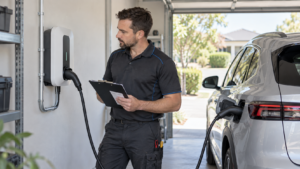
A typical 7 kW single-phase home EV charger costs $1,200 to $2,200 to supply and install, assuming your existing switchboard has enough capacity. A faster 22 kW three-phase charger runs $2,500 to $5,000 because of the extra phase wiring and equipment.
Budget for two possible extras:
- Switchboard upgrade, if needed: an additional $800 to $2,000. Many NSW homes need this before a 7 kW charger can be fitted.
- Smart or solar-diverting chargers: typically $1,800 to $3,000 for a solar-capable 7 kW unit, which costs more upfront but can cut running costs by charging from your own generation.
On running costs, an EV uses roughly 10 to 15 kWh per 100 km of range. At NSW residential electricity prices of about 20 to 30 cents per kWh, that is a few dollars per 100 km, which is the figure worth comparing against fuel. The cable run from the switchboard to the parking space is the single biggest variable in an EV charger installation quote, so tell your electrician exactly where the car will park before asking for a price.
How much does it cost to connect solar and a battery in NSW?
A 6.6 kW solar PV system costs about $4,000 to $8,000 installed in NSW before rebates. Adding home battery storage costs a further $8,000 to $16,000 depending on capacity.
Connection costs in NSW are more predictable than people expect. Systems up to around 10 kW generally attract no additional network connection fee from distributors such as Ausgrid or Endeavour Energy, though you will need a bi-directional meter, which usually costs $200 to $300 through your retailer, plus electrician labour for final connection and commissioning.
Batteries are the part of this market that changed most recently. Under the Commonwealth battery discount delivered through small-scale technology certificates, eligible home batteries between 5 kWh and 100 kWh receive an upfront discount worth roughly 30% of installed cost, with the certificate rate stepping down each year. The certificates only apply if the system is installed by a Solar Accreditation Australia accredited installer with battery endorsement, and if the product is on the approved battery list. Any switchboard work needed to support the system is quoted separately, which is worth confirming before you sign a solar contract. We handle that side as solar and battery connections rather than bundling it invisibly into a system price.
How much does an electrical safety inspection cost?
A basic pre-purchase or general safety inspection costs $200 to $350 for a standard home. That covers a visual check of accessible wiring, the switchboard and safety switches.
- Detailed inspection (adding thermal imaging and insulation testing): $400 to $700
- Rental property compliance check (smoke alarms, safety switches, general wiring): $150 to $250
- Annual solar system check (inverter and cabling): $200 to $400
Inspections are the cheapest line on this page and the one most likely to save you money. NSW Government safety guidance attributes around 40% of NSW house fires each year to electrical faults and appliances, which works out to roughly 1,800 preventable fires, and recommends testing your safety switches twice a year. Booking electrical safety inspections and testing before a fault becomes an emergency is a $250 decision that avoids a $500 one.
How much does an emergency electrician cost in NSW?
A same-night emergency call-out in NSW usually costs $180 to $350 as a minimum fee, with labour then billed at $150 to $250 per hour. Weekend and public holiday rates can reach 1.5 to 2.5 times standard charges.
| Standard hours | After hours and emergency | |
| Call-out fee | $80 to $150 | $180 to $350 |
| Hourly rate | $85 to $130 | $150 to $250 |
| Typical two-hour job | $250 to $410 | $480 to $850 |
| Best used for | Planned and non-urgent work | Genuine safety risks |
Timing costs more than the task. The same repair booked for Monday morning costs roughly half what it costs on a Saturday night.
Call it out immediately if there is burning smell, smoke, sparking, exposed live wiring, or a total power loss with no obvious cause. If a single circuit has tripped and resets fine, or a light is flickering, it can almost always wait until business hours.
Does an electrician cost more in regional NSW than in Sydney?
Base rates in regional NSW are often similar to or slightly lower than Sydney rates, but total job cost can end up higher because of travel. Contractors covering large service areas commonly add a fixed travel charge of $50 to $200 depending on distance, and there are fewer electricians available for after-hours work outside the metro areas.
Two habits keep regional costs down:
- Bundle jobs into one visit. If you are paying for travel anyway, the marginal cost of a second or third small job is mostly labour.
- Book ahead where you can. Emergency availability is thinner outside metro NSW, so urgent jobs carry a bigger premium.
We price the same way across New South Wales, from Sydney out to Newcastle, Wollongong and the regional centres, and travel is quoted upfront rather than added at the end.
Why do electricians charge $85 to $130 an hour?
The hourly rate covers far more than the electrician’s wage, and understanding the difference makes quotes easier to compare.
Wages are only one component. A qualified electrician’s minimum hourly pay is set by the Electrical Award (MA000025), and the current rate is a fraction of what a contractor charges out per hour.
The difference covers public liability insurance, licence renewals, vehicle and fuel, test instruments, superannuation, workers compensation, compliance paperwork, stock carried on the van, and unbilled travel between jobs. On a suburban run in Greater Sydney, we spend a meaningful part of every day in traffic that nobody is billed for.
The same award also explains after-hours pricing. It sets penalty rates for evening, weekend and public holiday work, so labour costs the contractor considerably more outside business hours. When the wage cost rises at the source, the charge-out rate follows.
Do you legally need a licensed electrician in NSW?
Yes. In NSW you must hold an electrical licence to carry out any electrical wiring work, regardless of the cost or type of work. There is no small-job exemption, which is why even a single new outlet has to go to a professional.
Part of what you pay for is the paperwork that proves the work was tested.
After the work, the person who carries out the electrical test must submit a Certificate of Compliance for Electrical Work (CCEW) as soon as practical and no later than seven days after testing, under the NSW electrical compliance requirements. Since 1 July 2026, all CCEWs must be submitted through the Building Commission NSW eCert portal, as handwritten and PDF forms are no longer accepted. Failing to supply a CCEW carries on-the-spot fines of up to $1,000 per occasion, and installation work that does not meet technical standards can attract penalties up to $550,000.
Ask for the CCEW before you accept a quote. If testing and certification are not accounted for in the price, the job is not finished when the electrician leaves.
Hourly rate or fixed-price quote: which is better?
Both pricing models are common in NSW, and each suits a different type of job.
| Hourly rate plus call-out | Fixed-price quote | |
| How you are charged | Per hour, plus a separate call-out fee | One total price for the job |
| When you know the cost | After the work is finished | Before the work starts |
| Risk of surprises | Higher, since a slow job costs more | Lower |
| Best for | Small, quick, predictable tasks | Most residential jobs |
Hourly billing can be cheaper on a task that genuinely takes ten minutes. For anything larger, or anything where the scope is not obvious from the doorway, a fixed quote protects you from an open-ended bill. Our approach is to diagnose first, then quote one total price for the whole job, so what appears on the quote is exactly what you pay.
How can you avoid surprise costs on electrical work?
Most bill shock comes from extras added after the job: stacked call-out fees, after-hours loading, and materials priced at the end. A few checks keep the number predictable.
- Get a fixed quote in writing before work begins, not just an hourly estimate.
- Confirm the call-out fee and whether it sits inside or outside the quoted price.
- Ask for an itemised quote showing labour, materials and GST separately.
- Check the CCEW is included, since certification is a legal requirement.
- Ask about travel charges if you are outside a metro area.
- Book standard hours wherever the job allows it.
- Bundle small jobs into a single visit to share the call-out and setup time.
- Book a periodic safety inspection so small faults are found before they become emergencies.
Frequently asked questions
How much does it cost to install a power point in NSW?
Installing a new indoor power point costs $150 to $280 per outlet, including labour, the outlet and GST. A double outlet adds only $20 to $40, and an outdoor weatherproof outlet runs $250 to $450.
How much does an electrician charge to install downlights?
Replacing an existing downlight with an LED costs $60 to $100 per fitting. If new cabling is needed, the price rises to roughly $180 to $300 per light. Installing several in one visit lowers the per-light cost.
How much does it cost to replace a fuse box in NSW?
Replacing an old fuse box with a modern switchboard costs $1,200 to $2,500 for a typical three-bedroom home, and $3,000 to $4,000 for larger homes or those adding high-demand loads. The price includes new circuit breakers and RCD protection.
Is it cheaper to hire an electrician on weekdays?
Yes. Booking standard business hours avoids the $180 to $350 after-hours call-out fee and the $150 to $250 hourly emergency rate. For any job that is not a safety risk, weekday booking is the simplest saving available.
Do you need a licensed electrician for small jobs in NSW?
Yes. NSW requires an electrical licence for all electrical wiring work regardless of cost or type, so DIY work such as adding an outlet or changing a hardwired fitting is illegal. The licensed electrician must also issue a Certificate of Compliance for Electrical Work.
Before you accept a quote
Electrician costs in NSW vary widely, but your invoice should never be a surprise. Ask for the price in writing, ask whether the call-out fee is inside or outside that price, and ask for the compliance certificate.
If you want a clear fixed price for your job before any work starts, contact our NSW team. We diagnose the work, quote one total price, and back every job with a 12-month workmanship warranty.