Installing a 7 kW home EV charger in Sydney costs $1,200 to $3,000 in 2026, including the charger and the electrician’s work. The charger itself usually costs $500 to $2,000, and installation labour usually costs $700 to $1,300. A simple job next to the switchboard can come in lower, while long cable runs or a switchboard upgrade can push the total past $3,000. All figures in this guide are in Australian dollars and include GST.
At Solus Spark, we handle EV charger installation across Greater Sydney, and we hold a 4.9-star average across our reviews. On most of our jobs, the distance between the switchboard and the parking spot moves the price more than the charger brand. We quote one fixed price after we look at the site, and every job carries a 12-month workmanship warranty.
Below is what each part of the job costs, what pushes the price up, what NSW law requires, and how to get a quote you can trust.
EV charger installation cost in Sydney at a glance
Most Sydney homes spend between $1,200 and $3,000 on a single wall charger, fully installed. Here is how that total breaks down.
| Cost item | Typical Sydney cost (2026) | Notes |
| Basic single-phase charger | $500 to $800 | Few or no smart features |
| Feature-rich smart charger | $1,000 to $2,000 | App control, scheduling, solar charging |
| Simple installation (charger beside switchboard) | $300 to $500 | Short cable run, spare board capacity |
| Typical installation | $700 to $1,300 | Most Sydney homes land here |
| Complex installation | $1,000 to $1,500 or more | Long runs, conduit, trenching |
| Extra cable | $10 to $15 per metre | Plus labour to run it |
| Switchboard upgrade (if needed) | $1,200 to $2,000 | Single-phase board overhaul |
| Typical total | $1,200 to $3,000 | Charger plus installation |
Sydney labour rates sit toward the upper end of national averages, so we would budget closer to the middle or top of these ranges unless your setup is very simple. For context on general labour rates and call-out fees, see our guide to what Sydney electricians charge.
How much does a home EV charger cost to buy?
A home EV charger costs $500 to $2,000 in 2026, depending on its power output and features.
- Basic single-phase chargers ($500 to $800): These deliver around 7 kW and charge the car reliably, but offer little control beyond plugging in.
- Mid-range smart chargers (around $1,500): These add Wi-Fi, an app, charge scheduling and load management.
- Tesla Wall Connector (around $800): A popular single-unit option among Sydney EV owners.
- Specialty and bi-directional units (up to $6,700): These cost far more and suit a small number of households, such as those planning vehicle-to-home setups.
Smart features raise the hardware price, but they can lower running costs. A charger that follows your solar output or waits for off-peak hours can pay back its premium over a few years of driving.
How much do electricians charge to install an EV charger in Sydney?
Installation labour for a home EV charger in Sydney usually costs $700 to $1,300. A very simple install, where the charger mounts beside the switchboard in a garage, can cost as little as $300 to $500. Many jobs with longer runs or extra work land at $1,000 to $1,500 for installation alone.
A standard installation covers:
- A dedicated circuit from the switchboard to the charger
- A new circuit breaker and RCD (safety switch) sized to the charger
- Cable and conduit run to the parking spot
- Mounting and connecting the charger
- Testing and commissioning
- The NSW compliance certificate (CCEW)
The biggest single variable is cable length. A charger mounted on the other side of the garage wall from the switchboard is a short, quick job. A charger at the end of a long driveway, with the switchboard at the front of the house, takes more cable, more conduit and more hours.
Which home EV charger do you need: power point, 7 kW or 22 kW?
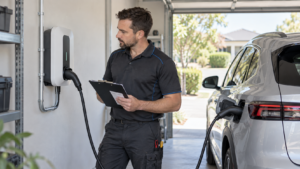
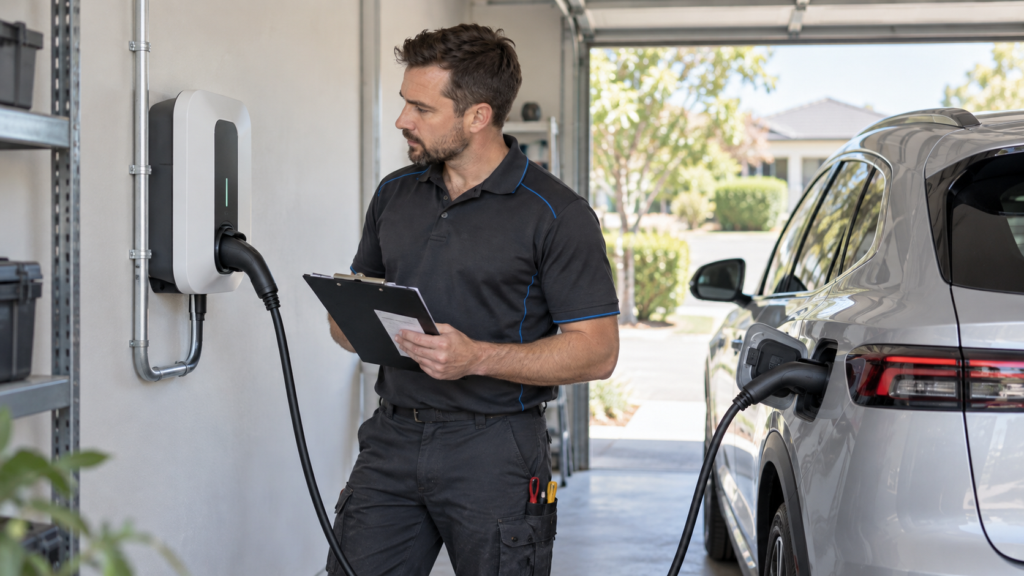
Most Sydney homes are best served by a 7 kW single-phase wall charger. It fully charges most EVs overnight and works on the single-phase supply that most houses already have.
The main home charging options compare like this, using figures from the ACT Government’s EV charging guide:
| Charging option | Power output | Range added per hour | Installation |
| Standard 10 A power point | 2.3 kW | Up to 15 km | None (uses existing outlet) |
| Single-phase wall charger | 7 kW | Up to 40 km | Dedicated 32 A circuit |
| Three-phase wall charger | 22 kW | Up to 130 km | Three-phase supply required |
Is charging from a normal power point enough?
Charging from a standard power point works for drivers who cover short distances each day. It needs no installation, but it is slow. The ACT Government estimates an 80 kWh battery takes about 35 hours to charge from empty on a standard socket. If you drive 40 km a day and park for 12 hours overnight, a power point may keep up. If you drive more, a wall charger makes life easier.
Is a 22 kW three-phase charger worth it?
A 22 kW charger only makes sense if your home already has three-phase power and your car can accept that rate. Many EVs sold in Australia top out at 11 kW on AC charging, even when plugged into a 22 kW unit. Three-phase chargers also cost more to buy and install. For most Sydney households, a 7 kW charger already fills the battery overnight, so the extra speed rarely changes daily life.
What makes an EV charger installation cost more?
Five factors decide whether your quote sits at the bottom or top of the range. Most of them are visible during a site inspection.
How far is your parking spot from the switchboard?
Cable costs around $10 to $15 per metre, plus the labour to run and secure it. Adding 20 metres of cable can add $200 to $300 in parts and labour. In our experience, this is the most common reason one Sydney quote is hundreds of dollars higher than another for the same charger.
Does your switchboard need upgrading?
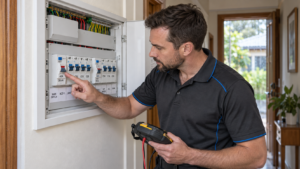
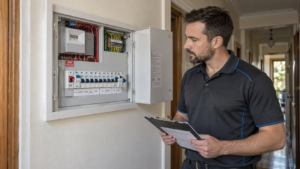
An EV charger needs its own breaker on the switchboard, usually rated at 32 A or 40 A. If the board is full, or it is an old fuse board, the electrician may recommend an upgrade before the charger goes in. A standard single-phase switchboard overhaul costs $1,200 to $2,000. At Solus Spark, we regularly find older Sydney boards with no spare space for a new high-load circuit. In those homes, the switchboard upgrade is often the largest line on the quote.
Can your electricity supply handle the extra load?
A 7 kW charger adds a large continuous load to your home. Most Sydney homes can support it without any grid work, particularly if the charger has load management that reduces charging when the oven or air conditioner runs.
Supply upgrades become relevant if a single-phase home needs three-phase power for a 22 kW charger, or if your main supply fuse is small. A minor service upgrade can cost around $600 plus new mains cable. In rare cases where the network needs a new pole or transformer, costs can climb into the tens of thousands, but this is extremely uncommon in suburban Sydney.
Does the cable need to go underground?
A wall-mounted charger with cable running along the garage wall is the cheapest setup. Costs rise when cable must be trenched across a lawn, cut through concrete, or run in underground conduit to a carport or detached garage. Every extra bend and every metre of trench adds labour time.
Do you want smart or solar charging features?
Smart chargers cost more upfront and can take longer to configure. Solar-aware chargers may also need a CT clamp or energy meter fitted at the switchboard so the charger can read your solar output. That adds hardware and setup time, but it lets the car charge on surplus solar instead of grid power.
Example EV charger installation costs for Sydney homes
These illustrative examples show how the same 7 kW charger can land at very different totals. They are built from the typical ranges above, not fixed quotes.
| Home setup | Charger | Installation | Extras | Likely total |
| Garage with switchboard on the same wall | $800 | $300 to $500 | None | $1,100 to $1,300 |
| Carport 15 metres from the switchboard | $1,500 | $700 to $1,300 | Extra cable and conduit | $2,200 to $3,000 |
| Older home with a full fuse board | $1,500 | $1,000 to $1,500 | Switchboard upgrade $1,200 to $2,000 | $3,700 to $5,000 |
The third example is common in older Sydney suburbs. When the switchboard needs work anyway, doing it in the same visit as the charger shares the shutdown, labour and certification across both jobs.
Can you install an EV charger in a Sydney apartment or strata building?
Yes, but apartment installs need approval from the owners corporation before any work starts. The strata committee will want to know where the circuit connects and how the electricity used by your charger is metered and billed.
The federal government’s guide to installing a charger in strata is a useful starting point before you approach the committee. Costs in apartment buildings vary much more than in houses, because cable runs through basements can be long and the building’s main switchboard may need a load assessment first.
Are there rebates for home EV chargers in NSW?
No. There is currently no NSW Government rebate for installing an EV charger at a standalone house, so Sydney homeowners pay the full cost.
The only recent NSW program was the EV Ready Buildings Grant, which covered up to 80% of electrical infrastructure costs, capped at $80,000, for residential strata buildings with 10 or more units. Applications closed in December 2023, and the program is not taking new applications. As of February 2026, it had approved about $6.97 million for 124 buildings.
What are the rules for installing an EV charger in NSW?
Only a licensed electrician can install a hard-wired EV charger in NSW. The work must comply with AS/NZS 3000 (the Wiring Rules), which requires a dedicated circuit, a correctly rated breaker and RCD protection for the charger.
When the job is finished, the electrician must lodge a Certificate of Compliance for Electrical Work (CCEW). Under NSW compliance requirements, the certificate must be submitted no later than seven days after testing. Since 1 July 2026, all CCEWs go through the Building Commission NSW eCert portal. Electricians who fail to supply one face on-the-spot fines of up to $1,000 per occasion.
A standard single-phase home charger does not need council approval or a separate permit. If you are changing your supply, such as moving from single-phase to three-phase, your network distributor (Ausgrid or Endeavour Energy in most of Sydney) will need an application. Your electrician should handle that paperwork and include it in the quote. For tips on checking licences and comparing contractors, see our guide on choosing an electrician in Sydney.
How much does it cost to charge an EV at home in Sydney?
Charging at home usually costs far less than public fast charging, especially overnight or on solar. To estimate a full charge, multiply your battery size in kWh by your electricity rate. For example, a 60 kWh battery charged at a rate of 20 cents per kWh costs $12 to fill from empty. Check your own bill for your actual off-peak rate.
Timing matters on Sydney’s network. Ausgrid’s time of use pricing sets the peak period at 3pm to 9pm during summer (November to March) and winter (June to August). A charger with scheduling can wait until after 9pm, which keeps charging out of the most expensive window without you having to remember.
If you have rooftop solar, daytime charging on surplus solar is the cheapest option of all. A solar-aware charger sends excess generation into the car rather than exporting it to the grid for a low feed-in tariff. We often set this up alongside solar and battery connections so the charger, inverter and switchboard work together.
Is a home EV charger worth the cost in Sydney?
For most Sydney EV owners, yes. A wall charger costs $1,200 to $3,000 once, and it pays you back in time, convenience and lower charging costs every week.
- Speed: A 7 kW charger adds up to 40 km of range per hour, compared with up to 15 km from a power point.
- Lower running costs: Off-peak and solar charging cost a fraction of public DC fast charging.
- Convenience: You leave home with a full battery each morning, with no detours or queues at public chargers.
- Safety: A dedicated circuit with RCD protection is safer for long, continuous charging than a standard household outlet.
- Home appeal: As more Sydney buyers drive EVs, a charger already installed in the garage is a practical selling point.
If you drive short distances, work from home or can charge at work, a power point may cover your needs for now. You can always add a wall charger later.
How to get an accurate EV charger installation quote in Sydney
Most surprise costs on EV charger jobs come from cable runs and switchboard work that were not priced upfront. A few steps keep your quote accurate:
- Send photos of your switchboard with the door open, so spare capacity can be checked early.
- Measure or describe the cable route from the switchboard to where the car parks.
- Tell the electrician your car model, since its maximum AC charging rate affects which charger makes sense.
- Ask whether a switchboard upgrade is included or priced separately.
- Confirm the CCEW is included in the price.
- Get a fixed price in writing rather than an hourly estimate.
If you buy your own charger, check with the electrician first that it suits your supply and your car.
Frequently asked questions
How much does it cost to install a Tesla Wall Connector in Sydney?
The Tesla Wall Connector costs around $800, and installation usually adds $700 to $1,300. That puts a typical Sydney total at about $1,500 to $2,100, before any switchboard upgrade or long cable run.
How long does a home EV charger installation take in Sydney?
A straightforward home EV charger installation in Sydney usually takes a few hours and is finished in one visit. Jobs involving trenching or a switchboard upgrade can take most of a day.
Can I install an EV charger myself in NSW?
No. NSW law requires a licensed electrician for all electrical wiring work, including hard-wired EV chargers. The electrician must also lodge a CCEW after testing.
Do I need three-phase power for a home EV charger?
No. A 7 kW single-phase charger works on the supply most Sydney homes already have and fully charges most EVs overnight. Three-phase power is only needed for 11 kW or 22 kW home charging.
Does a home EV charger need a switchboard upgrade?
Not always. If your switchboard has space for a new 32 A or 40 A breaker and RCD, no upgrade is needed. Older or full boards may need an upgrade costing $1,200 to $2,000.
Get a fixed price for your EV charger installation
Most Sydney homes pay $1,200 to $3,000 to install a home EV charger, and the cable run and switchboard decide where you land. Get those two items priced upfront, confirm the CCEW is included, and choose a charger that suits your car and your supply.
If you want a fixed price before any work starts, contact our Sydney team. We check your switchboard and cable route, quote one total price for the whole installation, and back every job with a 12-month workmanship warranty.